
Road construction
..using sustainable design
Road construction generally has the greatest impact on the environment.
In road construction, weak soil has often been replaced with natural gravel or blasted rock. However, this is no longer considered environmentally suitable. Below are some ideas developed by former VBk designers, hopefully some might be useful.
1. General principles for “green” road construction
Road construction largely consists of efficient earthworks and mass handling. To achieve this, the following is suggested:
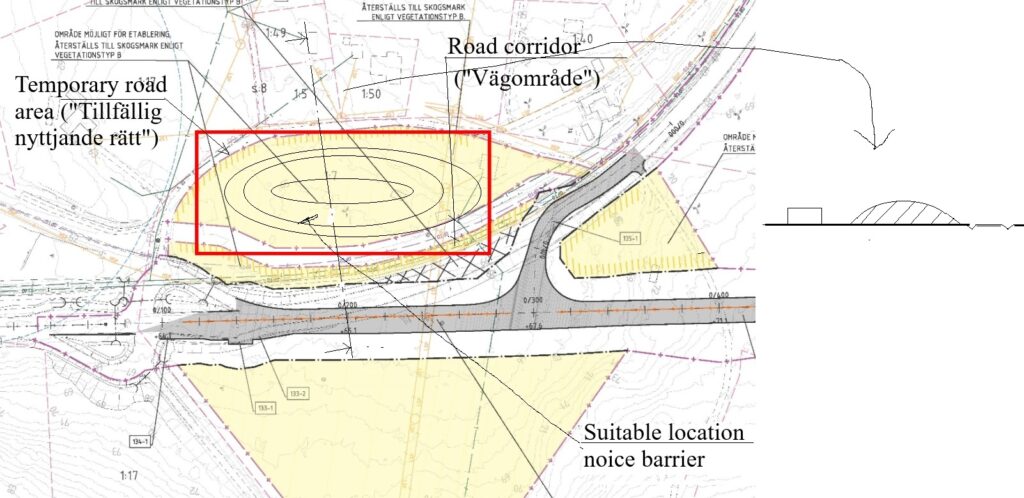
Land use areas (“tillfällig nyttjanderätt”) should be sufficiently large to allow mass transportation within the contract area without construction traffic needing to share routes with public road traffic.
The road corridor (“vägområde”) should be large enough to allow excavated materials that are not considered suitable as road material to instead be used for noise embankments or noise barrier.
One way to avoid purchasing unnecessarily large road areas is to investigate which temporary road areas (“områden med tillfällig nyttjanderätt”) are suitable for establishing permanent noise barriers already in the planning phase, in case the excavated materials cannot be used in the road construction.
In connection with land negotiations with the affected landowner, an option for future land acquisition can also be stipulated in the agreement. If this option is exercised, the area can be connected to the original road corridor (“vägområde”) after the road construction is completed.
If possible, no unbound materials should be imported into the road corridor (“vägområde”).
If unbound materials are required for the road structure, these should, where possible, be produced within the road corridor by utilizing rock cuts (“bergskärning”) and crushing the material to the required specification.
Layered lime-cement stabilization should be used to improve the bearing capacity of materials that would otherwise not be considered suitable for road construction. Also permits road construction to take place for a longer period of the year in countries with a Nordic climate.
2. Contaminated soil
Contaminated soils should be identified and documented. If it is not possible for them to remain as they are, they should be removed or stabilized using layered lime-cement in order to reduce the risk of contaminant migration.
3. Road construction on weak natural soil
Historically, there have been three different methods for constructing roads on weak natural soil:
- Replacing weak ground with gravel or crushed rock.
- Installing concrete piles with concrete slab at top (“bankpålning” or “påldäck”).
- Installing lime–cement columns.
Other more sustainable methods in future is seen below:
- Strengthen soil using layered lime-cement.
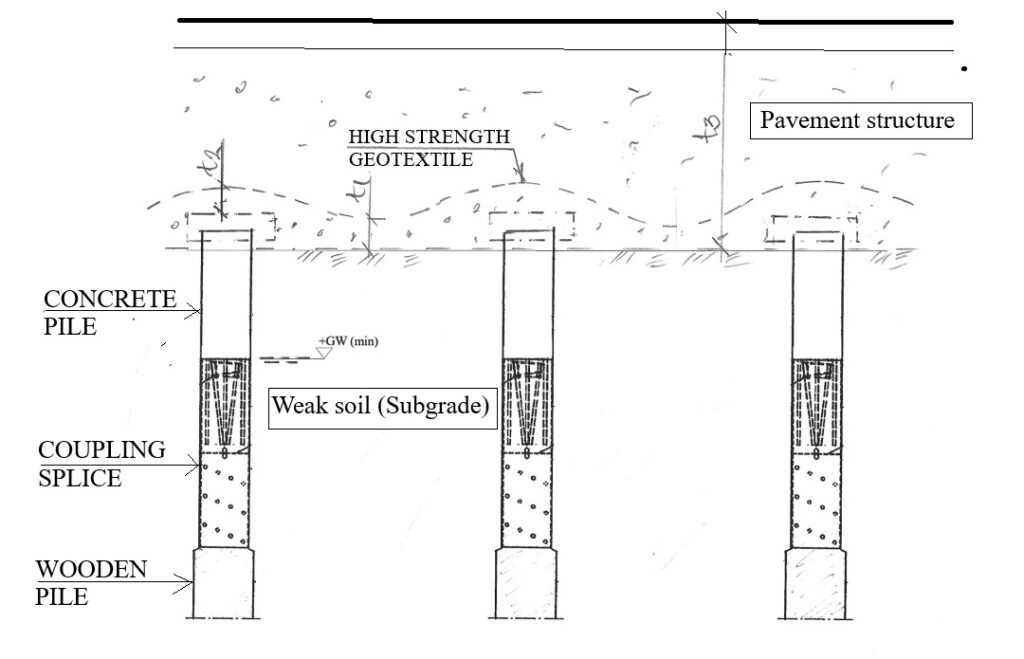
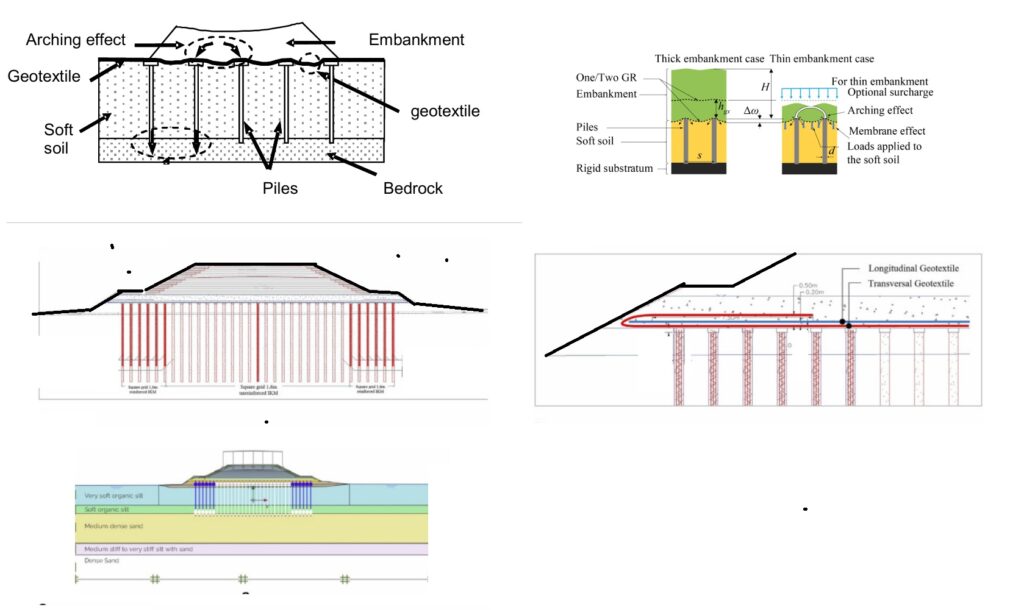
- Wooden piles with high strength geotextile at top.
- Road design using “detalied analysis”.
4. Road construction on frost susceptible natural soil
Historically, there have been two different methods for constructing roads on frost susceptible soil:
- Excavating frost susceptible soil and replacing with none susceptible.
- Thermal isolation (may become more used to achive “green” road construction).
A more sustainable method in future is changing material properties using layered lime-cement.
5. Strengthen weak subsoil using layered lime-cement
Layered lime-cement can be used to strengthen the existing soil material. The methodology is termed method 3.
6. Wooden piles with high strength geotextile at top
Wood piles with high strength geotextile at top might be a useful way to achieve more enviromental constructon. A transparent 3D analysis will be provided shortly.
7. Fiber mesh in flexible pavement structure with bound base layer
Using fiber mesh between bound base layer and unbound base layer is expected to reduce the thickness of the bound base course or extend life spann of pavement. Fiber mesh should be by either using carbon fiber or glass fiber.
8. Road design: assessment of fatigue (FAT) stress in pavement structure above the subgrade level
An analytical –empirical model is commonly applied to evaluate fatigue stresses and strains induced by traffic loads. The stresses and strains are generally determined using “simplified” 2D linear analysis.
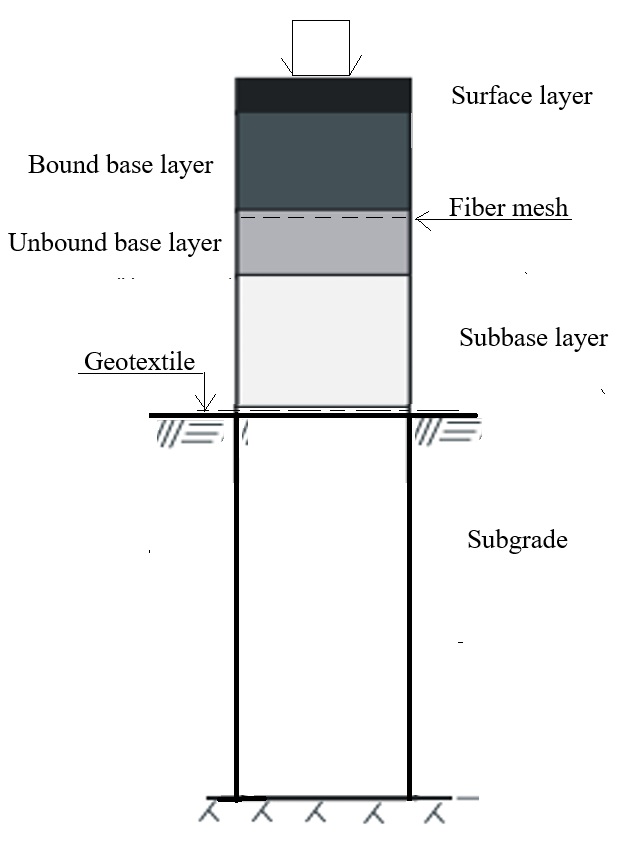
The determination of pavement stresses and strains can be improved by accounting for the influence of fiber mesh beneath the bound base layer, the advanced matieral behavior of the pavement materials, and the actual subgrade stiffness using a 3D none-linear analysis.
9. Road design: assessment of geotechnical bearing capacity (ULS) and deformations (SLS)
The design of road structures is commonly based on “simplified” 1D or 2D methods.
A more detailed 3D none-linear analysis may be conducted to account for advanced material behavior in both the pavement structure and the subgrade. The method is considered particularly advantageous for evaluating longitudinal variations in settlement (S) resulting from large variations in subgrade stiffness or when near structures (generally a bridge).
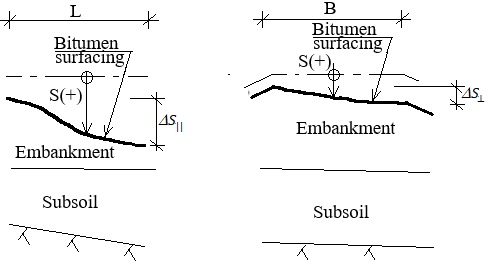
10. Advanced road design: combining assement fatigue (FAT), bearing capacity (ULS) & settlement (SLS)
Creating a advanced 3D-modell is demed to reduce material use in road contruction. A detailed transparent FEM-analysis using none-linear material properties using modified Mohr-Coulomb method will be provided shortly.
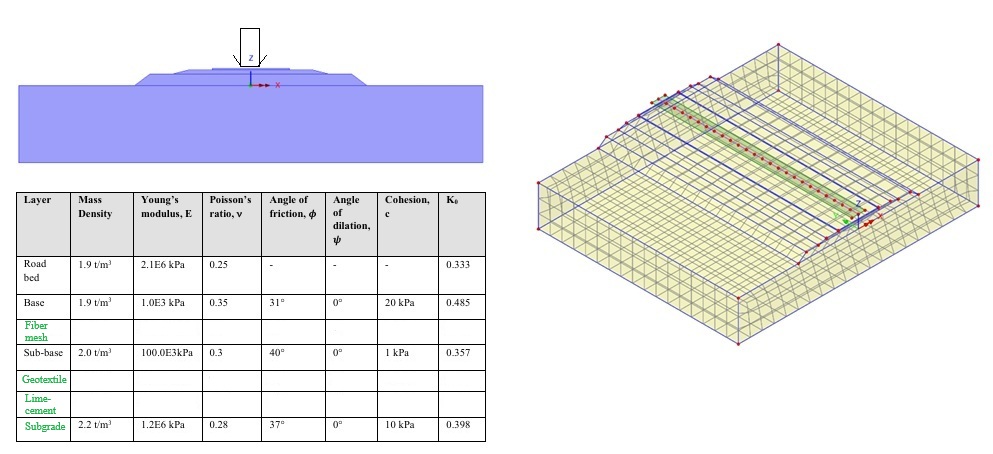
11. Concrete link slab at bridge approach
A detailed 3D none-linear analysis of longitudinal deformations (S) enables settlement criteria to be satisfied by adapting subgrade stiffness in the bridge transition zone. In addition, the risk of cracking may be reduced if fiber mesh is installed at the bottom of the bound base course. This is believed to reduce the need for concrete link slabs, thus less CO2 imprint and contribute to construction efficiency.